
D minor · 10 notes
Enixpan D Kurd 10 Notes
10 notes on top, Ø 55,9 cm, 4,5 kg. The classic size for a first handpan.
We make the D Kurd in two sizes: 10 notes at €1,590 and 13 notes at €2,790. Same D minor, same low D3 Ding; the 13-note version adds F3, G3, D5.
Open a model for photos, the full note layout, video and ordering.
10 notes on top, Ø 55,9 cm, 4,5 kg. The classic size for a first handpan.
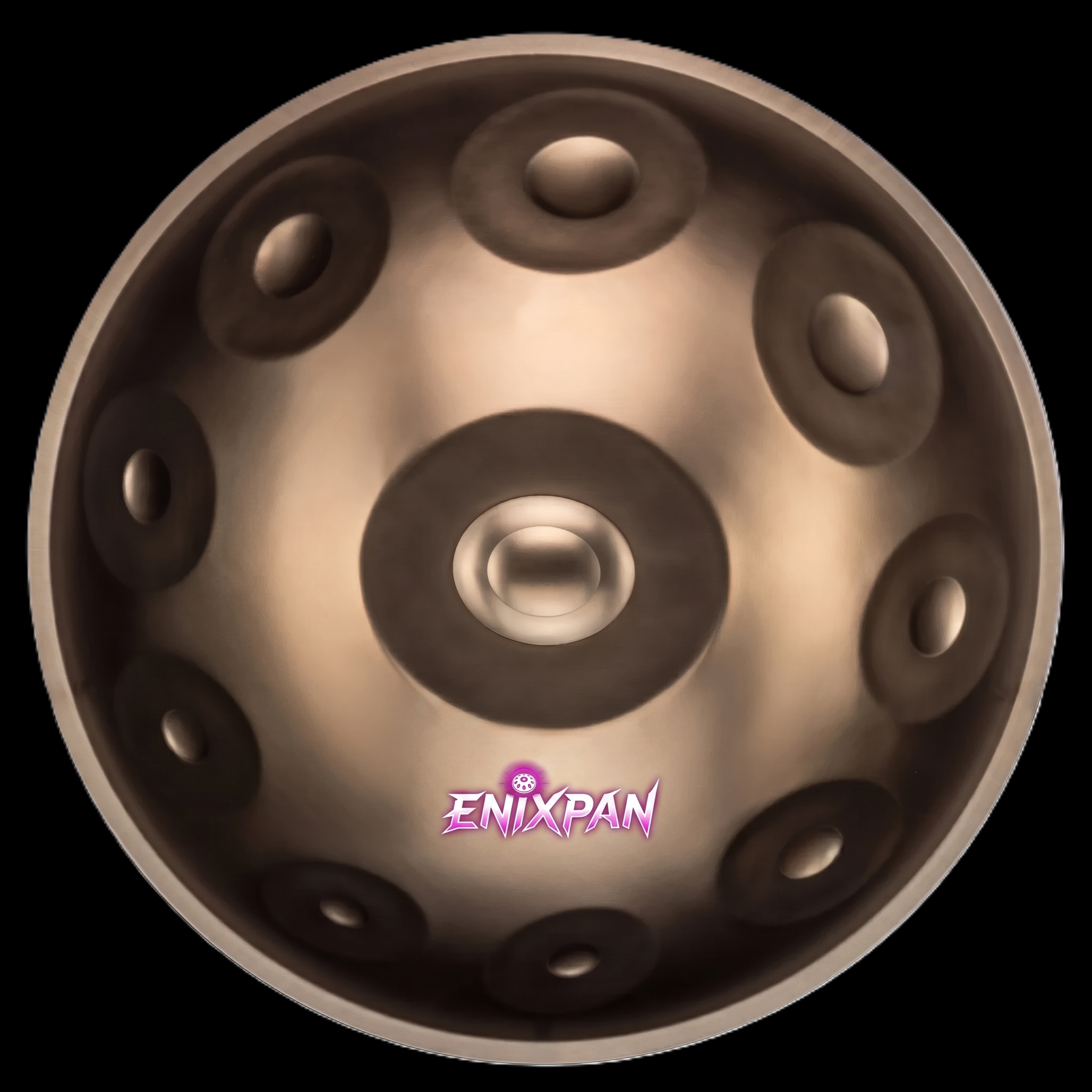
Every note of the D Kurd 10 plus F3, G3, D5: 10 on top, 3 underneath, Ø 53 cm.
For a first instrument, the D Kurd 10 is plenty. Its notes (D3, A3, B♭3, C4, D4, E4, F4, G4, A4, C5) cover all seven degrees of D natural minor, so melodies come quickly and nothing you play sounds wrong.
The D Kurd 13 is for players who already know the Kurd is their sound and want more room: F3, G3, D5 add two low notes between the Ding and A3 plus a higher D on top, handy for adding a bass line or playing alongside others.
You pay €1,200 more for those 3 notes. Still torn between two scales? Our D Kurd vs D Aegean guide compares them note by note, and how many notes a handpan should have covers the size question in general.
Want to compare both sizes? Nixis simulates each model from recorded samples. It gives you the notes, not the exact voice of your own instrument.
Start with 10: it is the complete scale, at €1,590. Go for 13 (€2,790) if you want F3, G3, D5 from day one, that is two more low notes and one extra high note.
The D Kurd is in D minor, soft with a touch of melancholy; the D Aegean is brighter and more open. Neither needs any music theory. Our D Kurd vs D Aegean guide goes through the notes one by one. Read the comparison →
It comes down to taste and use: 440 Hz is the standard if you play with other instruments, 432 Hz sits slightly lower. Both cost the same; you choose when you order. Read the tuning guide →