 Written by
 Search “hang drum” online and you will find everything: instruments at €3,000, others at €40, mesmerising videos and dubious listings. The confusion is total — and it is not your fault. “Hang”, “handpan” and “tongue drum” actually describe two very different families of instruments, separated by how they are made, how they sound, and a factor of ten in price. This guide untangles the three names once and for all.
The Hang: the Swiss original
It all starts in Bern, Switzerland, in 2000. Felix Rohner and Sabina Schärer, two steelpan makers, create at their PANArt workshop a new instrument: two steel shells glued into a saucer shape, a central dome and seven to eight notes hammered in a circle. They call it the Hang — “hand” in Bernese dialect, because it is played precisely with the hands, resting on the lap.
The Hang becomes a cult object: tiny production runs, purchase by written application, waiting lists of several years. PANArt stopped making it in the early 2010s to focus on other instruments. One detail matters: “Hang” is a registered trademark of PANArt. The term “hang drum”, popularised by the internet, was never an official name — the makers themselves reject it.
An authentic Hang has not been produced for years: it can only be bought second-hand, often at collector prices. Anything sold new under that name is something else.
The handpan: the generic instrument
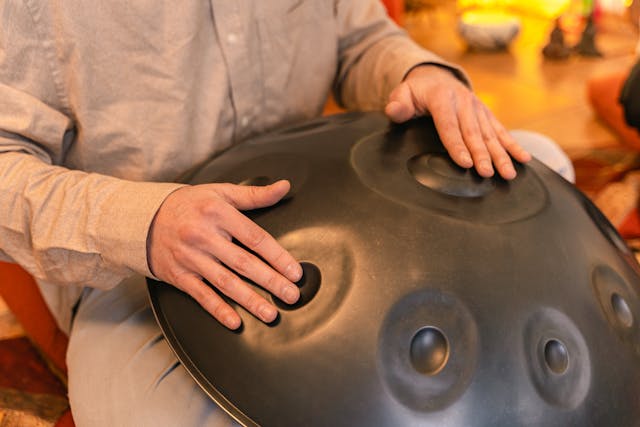
The Hang's success inspired dozens of workshops around the world. Since the name was protected, the community adopted a generic term around 2007: handpan. It covers the whole family of instruments descended from the Hang: a convex steel shell, a central Ding, and hammer-tuned tone fields all around — each note carrying its fundamental, its octave and its harmonic fifth, tuned by hand by a craftsman.
That craftsmanship is what defines a handpan: dozens of hours of precise hammering and tuning on treated steel (nitrided at Enixpan, for rust resistance and tuning stability). It also explains what a handpan costs: expect €1,500 to €3,000 for a serious workshop instrument. The sound is warm and enveloping, with rich interacting harmonics — it is the sound in the videos that brought you here. To understand how the notes are organised, see our guide what is a handpan scale.
The tongue drum: the budget cousin
The steel tongue drum was born around 2007, when tinkerers started cutting “tongues” into empty gas tanks. The idea was industrialised: today tongue drums are mass-produced, their tongues laser-cut into a thick shell, and sold between €30 and €300, often with mallets included.
The difference is not just the price: the sound is produced differently. On a handpan, a thin steel membrane tuned to three harmonics vibrates; on a tongue drum, a cut tongue oscillates at its single fundamental frequency. The result: a more crystalline, bell-like or music-box sound with long sustain — pretty, but without the harmonic richness or dynamics of a handpan. Tongue drums are often played with mallets; handpans almost always with the fingers.
Let's be clear: the tongue drum is not a scam — it is an honest instrument, perfect for a tight budget, for children, or as a first contact with intuitive music. It only becomes a problem when it is sold to you as a handpan.
Handpan or tongue drum: the comparison table
The essential differences, side by side:
| Criterion | Handpan | Steel tongue drum |
|---|---|---|
| Origin | Bern, 2000 (PANArt's Hang); generic term since 2007 | Around 2007, DIY origin then industrial production |
| Making | Hand-hammered and tuned, dozens of workshop hours | Laser-cut tongues, mass production |
| Sound production | Tone field tuned to 3 harmonics (fundamental, octave, fifth) | Tongue vibrating at a single frequency |
| Sound | Warm, rich, enveloping, very dynamic | Crystalline, bell or music-box like, long sustain |
| Playing | With the fingers, on the lap | With mallets or fingers, on a table |
| Price | €1,500 – €3,000 (serious workshop) | €30 – €300 |
| Best for | Expressive improvisation, concerts, sound healing, musical progression | Small budgets, children, first steps, relaxation object |
Which one to choose
You fell in love with a video — a warm, deep sound played with the hands? Then you are looking for a handpan. No tongue drum will reproduce that sound, whatever the listing says. Start with our guide choosing your first handpan and listen to the scales on the Nixis tester.
You want to give someone a first intuitive instrument without a real budget? A decent tongue drum is a fine gift — just know what you are buying, and what you are not.
You are hesitating because “it's the same but cheaper”? That is exactly the sentence that leads to disappointment. The two instruments share an aesthetic and a philosophy — intuitive music, no theory needed — but not a sound. Listen to both before deciding: ten seconds are enough to hear it.
The ten-second test: search “handpan” then “tongue drum” on any video platform and compare. Your ear will decide better than any product sheet.
The €100 “hang drum” trap
It is the classic marketplace trap: a “hang drum” or “handpan” listing at €80, €100 or €150, polished photos, description copied from a real workshop. At that price it is always a tongue drum — physically, no hand-hammered, hand-tuned handpan can cost that little. The buyer unboxes a metal bell where they expected the sound of a viral video, and the disappointment fills the one-star review columns.
Three checks before buying: the price (below €800, maximum suspicion about the word “handpan”); the photos (a handpan shows flattened tone fields with a central dimple, a tongue drum shows tongue-shaped cuts); the seller (an identifiable workshop that talks about its scales and tuning, rather than a generic listing). Our Enixpan model comparison shows what a serious product sheet looks like: scale, notes, frequency, level. Before you order, our checklist for buying a handpan online also covers lead times, customs, your right of withdrawal and payment.
Frequently asked questions
Are a handpan and a hang drum the same thing?
Yes and no: the Hang is the original instrument created by PANArt in 2000 (a registered trademark, no longer produced), and “handpan” is the generic name for the whole family. “Hang drum” is popular but improper — in practice it refers to a handpan.
What is the difference in sound between a handpan and a tongue drum?
A handpan sounds warm and rich: each note is tuned to three harmonics (fundamental, octave, fifth). A tongue drum sounds crystalline and bell-like, one frequency per tongue, with long sustain but far fewer nuances.
Why does a handpan cost ten times more than a tongue drum?
A handpan requires dozens of hours of hand hammering and tuning by a craftsman on treated steel. A tongue drum is laser-cut and mass-produced. The price difference reflects the difference in making — and in sound.
Is a tongue drum a good instrument to start with before a handpan?
To discover intuitive music on a small budget, yes. But the techniques differ (mallets vs fingers) and the sound is unrelated: if the handpan sound is what attracts you, a tongue drum will not replace it.
How can I tell whether a listing sells a real handpan?
Three clues: the price (a real workshop handpan costs well over €800), the photos (hammered tone fields with a central dimple, no tongue-shaped cuts) and the seller (an identifiable workshop stating scale, notes and tuning).
Going further
These guides will take you from curiosity to the right instrument:
Hear the difference for yourself
The Nixis tester faithfully reproduces the sound of every scale of our handpans. Listen, compare — then explore the shop.