 Written by
 The handpan has become one of the instruments of choice for sound healing practitioners around the world. Its rich harmonics, natural sustain and ease of improvisation make it a powerful tool for accompanying relaxation, meditation and wellness practices. This guide is intended both for practitioners wishing to integrate the handpan into their practice and for players curious about its therapeutic effects.
1. What is sound healing?
Sound healing is an ancient practice — Tibetan bowls, shamanic chants, didgeridoo — revisited in a contemporary wellness context. The principle: sound vibrations act on the body and mind to promote relaxation, emotional regulation and sometimes healing.
Today practiced by therapists, yoga practitioners, coaches and wellness musicians, sound healing is expanding rapidly. We distinguish mainly:
- The sound bath: participants lie down and "bathe" in the sounds produced by one or more instruments. Group format, often 5 to 30 people.
- Individual sound therapy: one-to-one sessions between a practitioner and a recipient, often combined with other modalities (massage, guided relaxation).
- Guided sound meditation: sound serves as a support for a meditative practice guided by the practitioner's voice.
In each of these contexts, the handpan integrates naturally thanks to its unique acoustic characteristics.
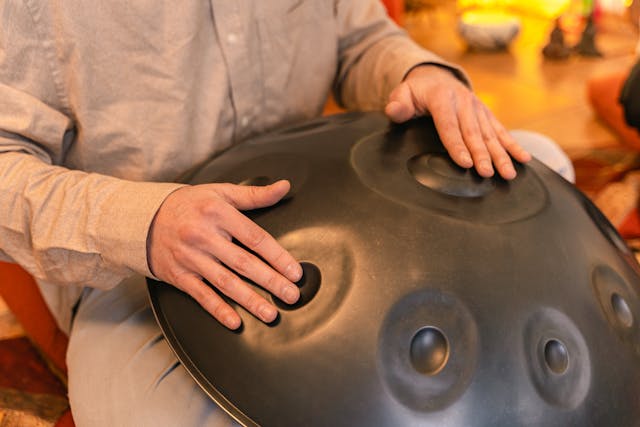
2. Why the handpan is ideal for sound healing
Among all the instruments used in sound healing, the handpan occupies a special place. Several characteristics make it particularly well suited:
- Rich, natural harmonics: each note of the handpan contains 3 partials (fundamental, octave, compound fifth) vibrating simultaneously, creating a vibrational complexity that the ear perceives as "round" and "warm".
- Long sustain: notes resonate for 3 to 8 seconds depending on the note and the strike. This natural sustain avoids "cutting" silences and maintains a continuous sound space.
- Closed scales: it is impossible to play "wrong". Improvisation is always musical, freeing the practitioner from technical concentration to focus entirely on their presence and the participants.
- Acoustic and vibrating instrument: unlike electronic or amplified instruments, the acoustic handpan generates physical vibrations that transmit directly into the air and can be physically felt by people nearby.
- Aesthetic and symbolic quality: the circular shape of the handpan, its "vessel" appearance, its dark matte texture — everything contributes to creating a visual ritual in addition to the sonic ritual. The instrument captures attention and invites contemplation before even a note is played.
Note: The handpan is one of the rare acoustic instruments that can be played at very low volume while retaining its character and harmonic richness — which makes it ideal for intimate spaces.
3. The scientific foundations: frequencies and the nervous system
Sound healing rests on documented physiological and neurological mechanisms. Here are the main ones, accessible without a scientific background:
Relaxation response and the parasympathetic nervous system
Continuous and predictable sounds activate the parasympathetic nervous system — the so-called "rest and digest" branch of the autonomic nervous system. This activation slows heart rate, lowers blood pressure and promotes deeper breathing. Low frequencies (200–400 Hz) are particularly effective at triggering this response.
Passive cardiac coherence
Listening to regular and rhythmic sounds can synchronize heart rate variability with breathing, a phenomenon known as cardiac coherence. In a sound healing session, the slow and steady rhythms of the handpan act as a gentle biological metronome, unconsciously guiding the cardio-respiratory system toward greater regularity.
Theta and delta brain waves
Neuroscience studies suggest that certain continuous sounds can favor the emergence of brain waves associated with deep meditation (theta waves, 4–8 Hz) and light sleep (delta waves, 0.5–4 Hz). The long sustain and harmonic complexity of the handpan create a sound environment conducive to this shift toward more relaxed states of consciousness.
Physically felt body vibration
Frequencies below 200 Hz can be physically felt as vibrations, particularly in the chest and abdomen. The deep notes of a handpan's Ding in C# or D produce these low vibrations that participants near the instrument can perceive directly in their bodies — a sensory dimension unique to acoustic sound healing.
About frequencies: The handpan, with its fundamentals between 130 Hz (C3) and 523 Hz (C5), covers the frequency range considered most effective for inducing relaxation. The Ding of the C Low Pygmy, on C3 (131 Hz), is the lowest of our 9- and 10-note models.
It is important to clarify that the therapeutic effects of sound healing are still under study and that existing research results vary by protocol. Sound healing does not replace medical treatment under any circumstances and must be positioned as a complementary wellness practice.
4. Recommended scales for sound healing
Not all handpan scales lend themselves equally to sound healing. Here are our detailed recommendations:
C Low Pygmy 9 notes — The top choice for sound healing
Notes: C3 / F3 G3 Ab3 C4 Eb4 F4 G4 Ab4 | Fundamental: C (131 Hz)
Its deep minor pentatonic scale and profound harmonics make it the reference instrument for practitioners. The low C Ding is particularly grounding — its low frequency resonates in the chest of nearby participants. The pentatonic scale with 5 notes makes any improvisation immediately fluid: the practitioner can concentrate entirely on their presence and the people they are accompanying, without ever fearing a "wrong note". Very popular for individual and group sound healing.
View the C Low Pygmy 9 notes →D Kurd 10 notes — The most versatile
Notes: D A Bb C D E F G A C | Fundamental: D (147 Hz)
Its natural minor is emotionally accessible and universal — beautiful to almost all ears, in almost all cultural contexts. Excellent for group sessions because its emotional spectrum is broad without being specific: each participant can project their own inner experience onto it. Compatible with other instruments (shruti box, bowls, voice) thanks to its clearly defined fundamental.
View the D Kurd 10 notes →E Amara 20 notes — Gentleness and breadth
Notes: E3 / B3 D4 E4 F#4 G4 A4 B4 D5 E5 F#5 G5 A5 + 7 bass notes | Fundamental: E (165 Hz)
A soft, luminous sound without being joyful. The Amara mode, a minor scale with no sixth often called "Celtic minor", suits individual sessions where you want to open a calm space without emotional charge: its minor third keeps depth, while the missing sixth avoids sadness. Its 20 notes let you hold a bass line and a melody at once, which makes it a favourite of experienced practitioners.
View the E Amara 20 notes →Tuning advice: For solo sound healing sessions or with other handpans, choosing 432 Hz is an option many practitioners prefer — some perceive it as warmer and more suited to wellness contexts. If you play with standard instruments (Tibetan bowls at fixed frequencies, other Western instruments), stay at 440 Hz to avoid dissonance.
5. Basic techniques for practitioners
The handpan is played with the fingers and palms of both hands, seated cross-legged or on a support. Here are techniques specific to the sound healing context:
- Opening with the Ding: always begin by playing the Ding alone for 30 to 60 seconds to "tune" the space and bring those present to the tonic. This ritual gesture marks the beginning of the session and invites inner silence.
- Continuous sustain: chain notes by letting each sound end naturally before playing another. Avoid long silences at the beginning of the session, when participants have not yet "entered" the space.
- The wave dynamic: play softly for 2–3 minutes, progressively increase volume and intensity, then descend gently. This structure mirrors the breathing cycle of the session and guides the experience without participants being aware of it.
- Harmonics on the edges: striking very gently on the outer edge of a note produces higher, more crystalline harmonics. Useful for "lifting" moments in the session — a change of texture that gently reawakens attention without breaking the flow.
- The Gu as resonator: placing one hand in the Gu opening (the central opening on the underside) while playing slightly modifies the resonance and harmonics. An advanced technique for varying sonic textures on the same instrument.
- Active silence: just as important as sound. After an intense phase, let silence settle for 20–30 seconds — this allows participants to integrate the experience. A silence "held" by the practitioner, conscious and present, has a different quality from simply stopping playing.
Posture: Hold the handpan flat on your knees, slightly tilted toward you, or place it on a low stand. The ideal height allows your forearms to rest naturally on the edges without tension in the shoulders. A relaxed posture translates into the sound.
6. Structuring a sound bath session (30 minutes)
A sound bath session with the handpan follows an arc structure — progressive rise, peak, descent — that mirrors the natural cycle of deep relaxation. Here is a template structure for 30 minutes:
Welcome and grounding
Very soft volume. Ding alone, then first lateral notes. Slow rhythm, generous spacing between notes. Allow participants to settle into their bodies and detach from everyday life.
Rise
Progressive enrichment of playing. More notes chained together, slight increase in volume. Introduction of gentle rhythmic patterns. Participants enter a deeper state of relaxation.
Peak
Most expressive playing. More present volume. More pronounced dynamic variations — nuances between soft and loud, slight accelerations followed by decelerations. This is the heart of the session, the most emotionally rich moment.
Descent
Progressive return to gentleness. Slowing of tempo. Fewer notes, greater spacing. Sound density decreases gradually, preparing the return to ordinary consciousness.
Closing
A few Ding notes alone to "close" the session, mirroring the opening. Let the last note resonate until complete silence. This final silence is part of the session — do not rush it.
Variable duration: For a 60-minute session, double the rise and descent phases and lengthen the peak. For a short integration (15 min), reduce each phase proportionally but keep the 5-part arc.
7. Handpan alone or in a duo?
The handpan works remarkably well solo — it is even its natural configuration for the majority of beginner practitioners. Concentration is total, the practitioner fully controls the sound space. But duo combinations open additional dimensions:
Handpan + shruti box
The most popular combination among experienced practitioners. The shruti box maintains a continuous harmonically coherent drone with the handpan, creating a sound "carpet" on which the handpan "dances". Result: harmonic richness without additional effort for the handpan player. Ideal for long sessions.
Handpan + Tibetan bowls
The bowls create crystalline textures and long resonances that the handpan ideally complements. Alternating between the two instruments allows texture variation without rupture — the bowl takes over while the handpan rests, and vice versa. Two practitioners can work together in full awareness of each other.
Handpan + voice
Very powerful but more demanding — the voice is the most direct and intimate instrument. The combination works best without microphones, in pure acoustics, to preserve vibrational authenticity. The practitioner can hum or sing vocal drones while playing, which requires specific practice.
Two handpans in duo: Two handpans tuned to the same tonic (e.g. two D Kurds) create a very rich texture — the players respond and complement each other naturally. Two handpans in different tonics (e.g. D Kurd + E Amara) require good harmonic mastery to avoid unwanted dissonance. Make sure both instruments are tuned to the same temperament (440 Hz or 432 Hz).
8. Training in sound healing with the handpan
Sound healing with the handpan is a discipline that is built progressively. Here is a structured training path:
First and foremost: be a recipient
Attend at least one sound healing session as a "recipient" before practicing. This experience is irreplaceable — it gives you a sensory reference for what your participants experience, and allows you to understand from the inside what sound can provoke.
Daily personal practice
Start by playing for yourself for 15 minutes a day. Sit comfortably, close your eyes, improvise without a goal. This personal work is the foundation of any sound healing practice — you cannot guide someone to where you have not been yourself.
Resources and training
- Sound healing associations: the Sound Healers Association and similar bodies list certified practitioners and offer recognized training programs.
- Online training: platforms such as iHandpan and the Sound Healing Academy offer curricula specific to the use of the handpan in therapeutic contexts.
- Immersive retreats: retreats combining handpan and wellness practices (yoga, meditation) are multiplying across Europe — they offer accelerated learning in an immersive context.
Our practical advice
Start with the D Kurd or the C Low Pygmy, practice free improvisation for 15 minutes a day for 3 months. By the end of this time, you will have developed an instinctive relationship with your instrument that will allow you to accompany your first sessions with confidence — without getting lost in the notes, without distracting your participants.
First step: Use our Nixis tester to explore the scales and choose the one that resonates most with your practitioner's sensibility. Your intuition is the best compass.
Find your handpan for sound healing
Explore our selection or test each scale in real time with Nixis, our interactive sound tester.